Choosing the right paint and coating production equipment is one of the most important decisions when starting a paint manufacturing business or upgrading an existing production line. The equipment directly affects product quality, production efficiency, energy consumption, labor costs, and the long-term stability of the factory.
Different types of paints and coatings require different production processes and equipment configurations. A small laboratory or startup factory may need a simple semi-automatic production system, while a large-scale manufacturer may require a complete automatic paint production line with PLC control, high-efficiency dispersing, grinding, mixing, storage, and filling systems.
This guide explains the main types of paint manufacturing equipment, how they work, and the key factors to consider when selecting equipment for your factory.
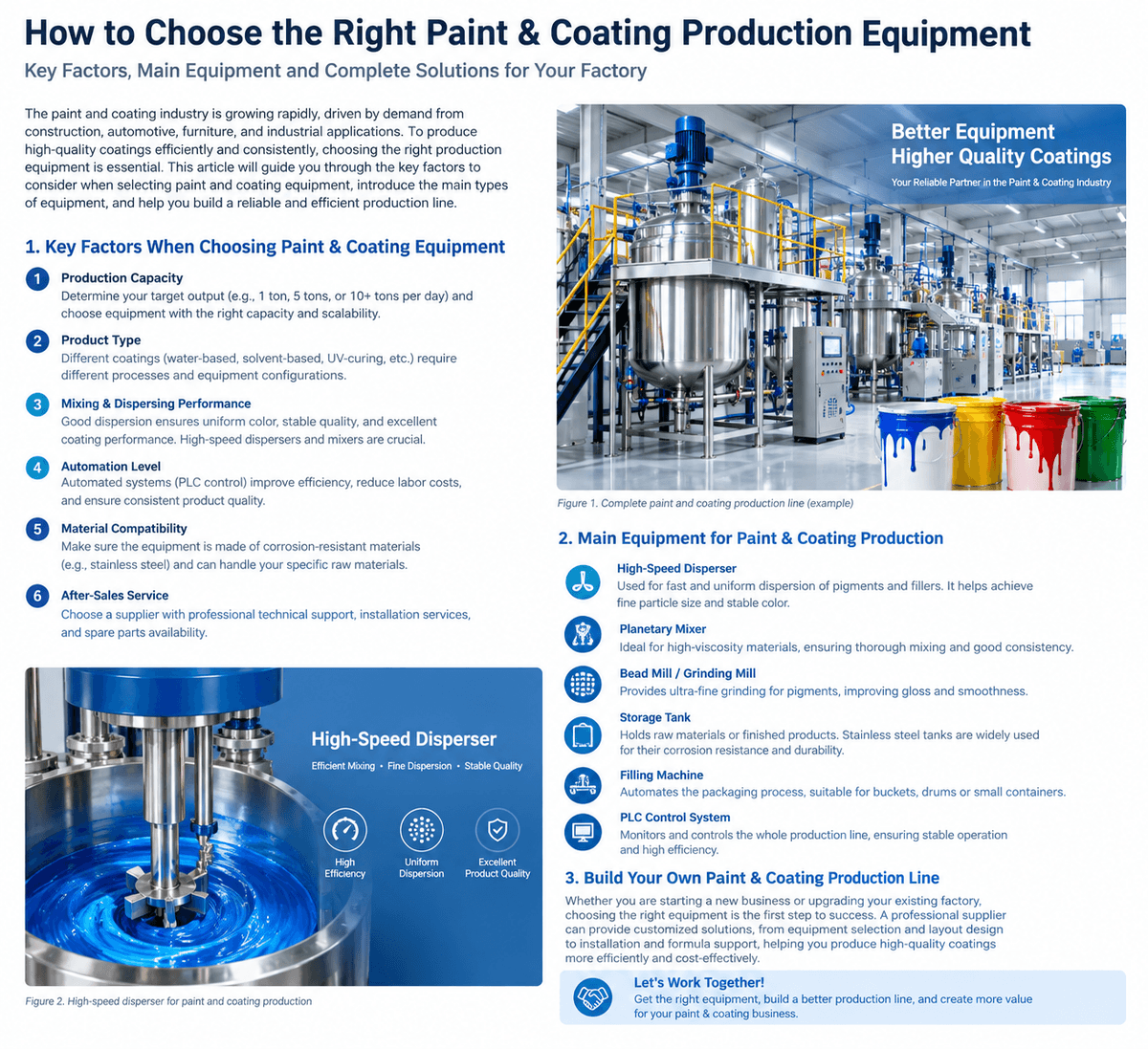
What Is Paint and Coating Production Equipment?
Paint and coating production equipment refers to a series of machines used to process raw materials such as resins, pigments, solvents, additives, fillers, and water into finished coating products.
A typical production process may include:
Raw Material Feeding → Mixing → Dispersion → Grinding → Blending → Filtration → Storage → Filling
Depending on the formulation and product requirements, not every production line needs all of these processes.
For example, some architectural water-based paints can be produced mainly through mixing and high-speed dispersion, while high-performance industrial coatings may require additional grinding and more precise temperature and viscosity control.
Therefore, equipment selection should always begin with the product formulation and production process, rather than simply choosing machines based on price or capacity.
1. Key Factors When Choosing Paint Production Equipment
Before purchasing paint manufacturing equipment, manufacturers should consider several important factors.
1.1 Production Capacity
Production capacity is one of the first specifications to determine.
For example, a new manufacturer may initially require:
500 kg per batch
1 ton per batch
2 tons per batch
5 tons per batch
10 tons or more per batch
The equipment should match both your current production requirements and your expected future growth.
Buying equipment that is too small can create production bottlenecks. However, purchasing an oversized production line can increase the initial investment, energy consumption, and unnecessary operating costs.
A professional equipment manufacturer can help calculate the appropriate mixing tank volume, disperser power, grinding capacity, storage capacity, and filling speed based on the target output.
2. Understand Your Paint or Coating Type
Different coatings require different manufacturing processes.
Common products include:
Water-based paint
Interior wall paint
Exterior wall paint
Acrylic paint
Industrial coatings
Protective coatings
Anti-corrosion coatings
Floor coatings
Wood coatings
Automotive coatings
Architectural coatings
Solvent-based coatings
High-viscosity coatings
For example, water-based paint usually requires efficient dispersion of pigments and fillers in an aqueous system. High-viscosity coatings may require stronger mixing and specialized mixers.
Some solvent-based products may also require equipment designed with appropriate safety considerations for flammable materials.
Therefore, the paint formulation, viscosity, solid content, particle size, and raw material characteristics should be considered before selecting the equipment.
3. High-Speed Disperser: One of the Most Important Machines
The hi
gh-speed disperser is one of the most widely used machines in paint and coating production.
It is primarily used to disperse pigments, fillers, powders, and other solid materials into a liquid medium.
During operation, a high-speed dispersion disc generates strong shear forces and creates circulation within the mixing tank. This helps break down pigment agglomerates and achieve a more uniform dispersion.
Main advantages of a high-speed disperser include:
Fast pigment dispersion
Improved color uniformity
Better raw material wetting
Reduced mixing time
Improved production efficiency
Suitable for many types of coatings
High-speed dispersers are available in different configurations and power ratings. The appropriate model depends on factors such as batch size, viscosity, formulation, tank diameter, dispersion requirements, and production capacity.
For small-scale production, a compact hydraulic or lift-type disperser may be sufficient. For larger production facilities, industrial high-speed dispersers can be integrated into automated production lines.
4. Paint Mixing Tank
The mixing tank is another essential component of a paint production system.
A mixing tank provides the working space where liquid raw materials, pigments, additives, resins, and other ingredients are blended.
Depending on the application, mixing tanks can be equipped with different agitators, including:
Propeller agitators
Paddle agitators
Anchor agitators
High-speed dispersing discs
Double-shaft agitators
Multi-shaft mixing systems
The tank can also be customized with additional functions such as:
Heating
Cooling
Vacuum mixing
Temperature control
Bottom discharge
Load cells
Spray cleaning systems
For water-based paints and relatively low-viscosity coatings, conventional mixing systems may be sufficient. For high-viscosity materials, more powerful and specialized mixing equipment may be required.
5. Bead Mill and Grinding Mill
For coatings that require fine particle size and high-quality dispersion, a bead
mill or grinding mill may be necessary.
The grinding process further reduces particle size and improves the dispersion of pigments and other solid materials.
Bead mills are commonly used in applications where manufacturers require:
Fine particle size
Smooth coating texture
High color strength
Better gloss
Improved dispersion stability
Different grinding technologies can be selected according to the product formulation.
For example, some coating products may use horizontal bead mills, while other applications may use three-roll mills or other grinding equipment.
The choice depends on the required fineness, material viscosity, throughput, and final product specifications.
6. Planetary Mixer for High-Viscosity Materials
A plane
tary mixer is particularly useful for high-viscosity materials that are difficult to process with conventional agitators.
The planetary mixing mechanism allows the mixing elements to move through the material while rotating around their own axes and around the mixing vessel.
This produces strong and comprehensive mixing.
Planetary mixers are commonly used for products such as:
High-viscosity coatings
Sealants
Adhesives
Putty
Thick pastes
Specialty industrial materials
Vacuum planetary mixers can also be used when removing trapped air or bubbles is important for the final product.
7. Storage Tanks
After mixing and processing, finished paint may need to be transferred to a storage tank before filling.
Storage tanks can be used for:
Raw material storage
Intermediate product storage
Finished paint storage
Additive storage
Resin storage
Water storage
Stainless steel is commonly selected for many applications because of its corrosion resistance, durability, and ease of cleaning.
Depending on the product, storage tanks may also include:
Agitators
Heating or cooling jackets
Level sensors
Temperature sensors
Bottom valves
Filtration systems
Automatic weighing systems
The storage system should be designed according to the production capacity and material characteristics.
8. Filling Machine for Paint Packaging
Once the paint has passed quality inspection, it needs to be filled into containers.
A paint filling machine can significantly improve packaging efficiency and reduce manual labor.
Common packaging options include:
Plastic buckets
Metal cans
Drums
Small containers
Large industrial containers
Filling machines can be designed for different levels of automation.
Semi-Automatic Filling
Semi-automatic systems are suitable for small and medium-sized manufacturers. Operators typically place containers under the filling heads and control the filling process.
Automatic Filling
Automatic filling systems can integrate:
Automatic container feeding
Automatic weighing
Filling
Container positioning
Capping
Labeling
Conveyor systems
For large-scale factories, automatic filling can significantly improve production efficiency and consistency.
9. PLC Control and Automation
Modern paint manufacturing plants increasingly use PLC cont
rol systems to improve production efficiency and process consistency.
A PLC-based control system can monitor and control important parameters such as:
Mixing speed
Dispersion time
Temperature
Material quantity
Pump operation
Tank level
Production sequence
Automation can reduce manual operation and help standardize the manufacturing process.
For large production facilities, a centralized control system can connect multiple machines and production stages, allowing operators to monitor the complete production process from a control panel.
However, full automation is not always necessary.
For smaller factories, a semi-automatic system may provide a better balance between investment, flexibility, and production efficiency.
10. How to Choose Equipment Based on Production Scale
Different factories require different equipment configurations.
Small Paint Production Factory
For a small startup factory, a basic production system may include:
Mixing tank
High-speed disperser
Transfer pump
Storage tank
Simple filling machine
This configuration offers relatively low investment and flexible production.
Medium-Scale Paint Factory
A medium-scale factory may require:
Raw material tanks
High-speed dispersers
Mixing tanks
Grinding equipment
Storage tanks
Filtration system
Filling machine
PLC control system
This configuration provides higher production efficiency and better process control.
Large Paint Manufacturing Plant
A large-scale factory may use a complete automated production system consisting of:
Raw Material Storage → Automatic Dosing → High-Speed Dispersion → Grinding → Mixing → Filtration → Finished Product Storage → Automatic Filling
The system can be customized according to production capacity, product type, factory layout, and automation requirements.
11. Water-Based Paint vs. Solvent-Based Coating Equipment
One important consideration is whether the product is water-based or solvent-based.
Water-Based Paint Equipment
Water-based coatings commonly use:
Stainless steel mixing tanks
High-speed dispersers
Agitators
Grinding mills
Storage tanks
Filling machines
The exact equipment configuration depends on the formulation and viscosity.
Solvent-Based Coating Equipment
Solvent-based coatings require additional attention to process safety and equipment compatibility.
Depending on the materials being processed, manufacturers may need appropriately designed:
Mixing systems
Explosion-protected electrical components
Ventilation systems
Sealing systems
Solvent handling systems
Temperature control systems
The production equipment should always be designed according to the applicable safety requirements and the characteristics of the specific formulation.
12. Why Equipment Customization Matters
There is no single paint production machine that is ideal for every factory.
Two manufacturers producing different coatings may have completely different equipment requirements, even if their annual production capacity is similar.
Equipment selection should consider:
Product formulation
Batch size
Production capacity
Material viscosity
Pigment loading
Required fineness
Mixing time
Factory space
Automation level
Energy consumption
Future production expansion
For this reason, experienced equipment manufacturers usually provide customized solutions instead of simply selling standard machines.
A customized paint production line can integrate individual machines into one coordinated system, improving production flow and reducing unnecessary manual handling.
13. Complete Paint Production Line
A complete paint production line may contain several interconnected systems.
A typical production process can be arranged as:
Raw Material Storage
↓
Automatic or Manual Dosing
↓
Premixing
↓
High-Speed Dispersion
↓
Grinding
↓
Fine Mixing
↓
Filtration
↓
Finished Product Storage
↓
Filling and Packaging
The actual process may be simplified or expanded according to the formulation.
For example, some water-based architectural paints may not require intensive grinding, while high-performance industrial coatings may require additional grinding and temperature control.
A professional manufacturer should therefore design the process around the customer's actual formulation rather than using a fixed equipment list.
14. What to Consider When Choosing a Paint Equipment Manufacturer
Choosing the right supplier is just as important as choosing the equipment itself.
Before placing an order, manufacturers should evaluate:
Engineering Experience
Does the supplier have experience designing complete paint and coating production lines?
Equipment Quality
Check the materials, components, motors, control systems, welding quality, and manufacturing standards used in the equipment.
Customization Capability
Can the supplier modify the tank size, disperser power, agitator type, control system, and production layout according to your requirements?
Installation and Commissioning
A reliable supplier should be able to provide technical support for equipment installation, commissioning, and operator training.
Formula and Process Support
Equipment alone does not guarantee a successful coating product. Understanding the relationship between the formulation and production process is equally important.
After-Sales Service
Spare parts, technical support, troubleshooting, and maintenance assistance are important for long-term production.
15. How Much Does Paint Production Equipment Cost?
The cost of a paint production line can vary significantly.
The final investment depends on factors such as:
Production capacity
Number of tanks
Disperser power
Grinding system
Automation level
Filling capacity
Stainless steel grade
Electrical components
Factory layout
Customized functions
A small semi-automatic production line may require a relatively modest investment, while a large fully automatic coating production plant can require substantially more capital.
Instead of focusing only on the initial equipment price, manufacturers should evaluate the total cost of ownership, including energy consumption, labor requirements, maintenance, spare parts, production efficiency, and expected service life.
The lowest purchase price does not always mean the lowest production cost.
16. Common Mistakes When Buying Paint Production Equipment
Several mistakes can lead to unnecessary investment or poor production performance.
Choosing Equipment Only by Price
Cheap equipment may have limitations in motor power, materials, components, control systems, or service support.
Buying Equipment Without Confirming the Formula
The equipment should be selected according to the actual formulation and process requirements.
Ignoring Future Expansion
If production is expected to increase, the factory layout and equipment configuration should allow future expansion.
Choosing the Wrong Disperser
The disperser power and blade design should match the material and batch size.
Over-Automating a Small Factory
A fully automatic line may not be economically appropriate for a small production operation.
Under-Automating Large Production
Too much manual operation can increase labor costs and create inconsistencies in large-scale manufacturing.
The best solution is usually the one that matches the actual production requirements and business plan.
17. Build a Paint Production Line According to Your Business Plan
Selecting paint and coating production equipment should be considered as a complete engineering project rather than simply purchasing individual machines.
A professional solution should consider:
Product → Formula → Process → Capacity → Equipment → Factory Layout → Automation → Packaging
This approach helps ensure that all machines work together efficiently.
Whether you are planning a small paint factory, expanding an existing coating plant, or developing a new industrial coating production line, customized equipment selection can help reduce unnecessary investment and improve long-term production efficiency.
Conclusion
Choosing the right paint and coating production equipment is essential for producing consistent, high-quality coatings while maintaining efficient and economical production.
The most important equipment may include high-speed dispersers, mixing tanks, grinding mills, bead mills, planetary mixers, storage tanks, filling machines, and PLC control systems. However, the ideal configuration depends on the product formulation, production capacity, viscosity, required particle size, factory layout, and desired level of automation.
Instead of selecting equipment based only on price or machine specifications, manufacturers should work with an experienced supplier that can provide equipment selection, production line design, factory layout, installation, commissioning, and technical support.
With the right equipment configuration and production process, a paint manufacturing factory can achieve better product quality, higher production efficiency, lower operating costs, and greater flexibility for future growth.
If you are planning a new paint or coating production line, the first step is to determine your product type, target production capacity, and manufacturing process. From there, the equipment can be selected and customized to meet your specific requirements.