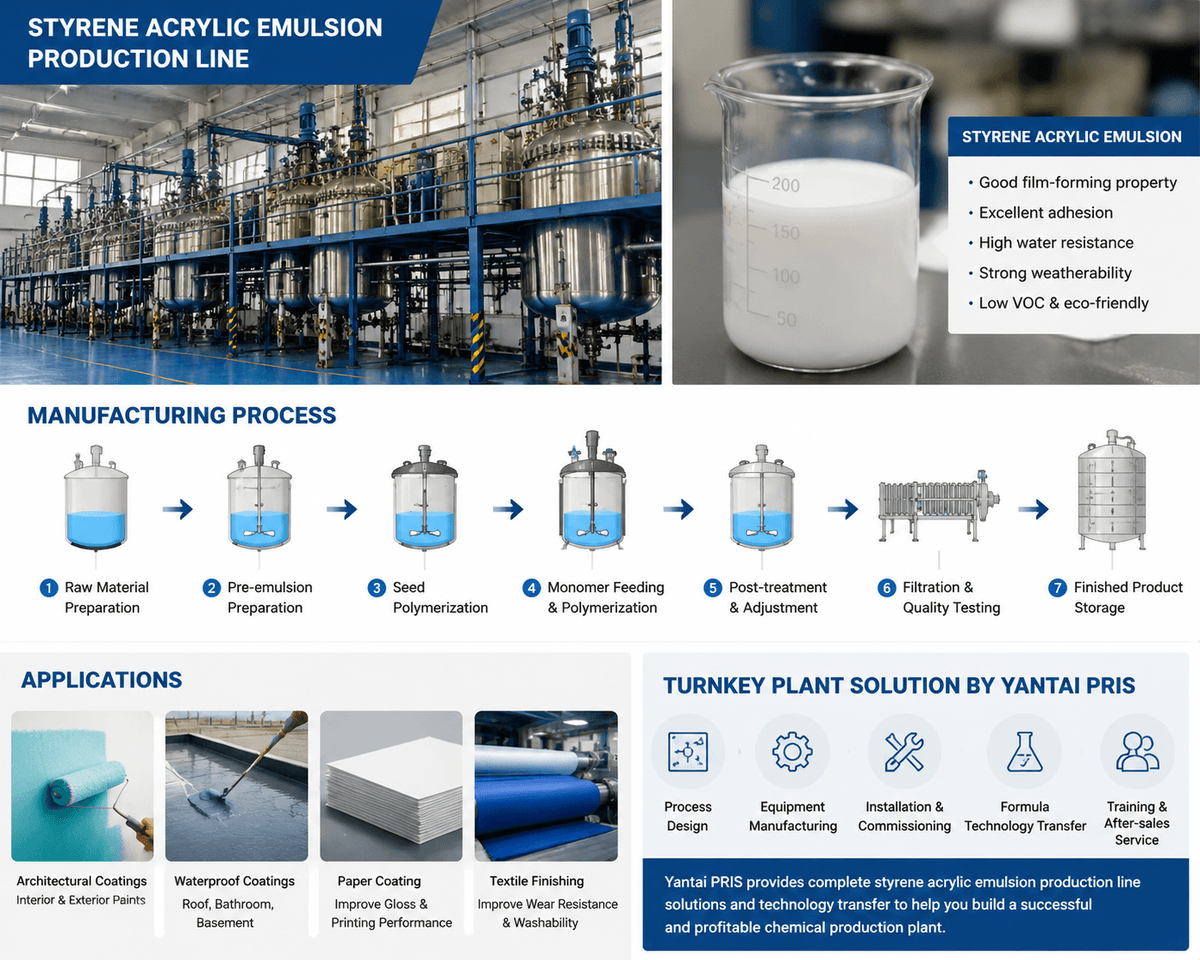
Styrene acrylic emulsion is one of the most widely used water-based polymer emulsions in the global coatings industry. Due to its excellent balance of hardness, flexibility, adhesion, water resistance and cost performance, it is widely applied in:
Architectural coatings
Waterproof coatings
Industrial coatings
Paper coating
Textile finishing
With the increasing demand for environmentally friendly water-based coatings, many companies are investing in styrene acrylic emulsion production plants to supply high-performance coating raw materials for local markets.
However, producing stable and high-quality styrene acrylic emulsion requires advanced emulsion polymerization technology, reliable production equipment and optimized formulation know-how.
Yantai PRIS provides complete styrene acrylic emulsion production solutions, including production line design, equipment manufacturing, process technology and formula technology transfer for customers worldwide.
What Is Styrene Acrylic Emulsion?
Styrene acrylic emulsion is a water-based polymer dispersion produced through emulsion polymerization using styrene and acrylic monomers.
By adjusting the monomer ratio and polymer structure, manufacturers can customize the emulsion properties according to different applications.
The main advantages include:
Excellent hardness and durability
Good flexibility and crack resistance
Strong adhesion
High water and alkali resistance
Good weatherability
Low VOC environmental performance
It has become an important raw material for modern water-based coating manufacturing.
Main Raw Materials of Styrene Acrylic Emulsion
A typical styrene acrylic emulsion formula contains several key components:
1. Styrene
Styrene works as a hard monomer and improves:
Film hardness
Wear resistance
Chemical resistance
However, excessive styrene content may reduce flexibility and increase cracking risks.
2. Acrylic Monomers
Common acrylic monomers include:
Butyl acrylate (BA)
Methyl methacrylate (MMA)
They provide:
Better flexibility
Improved adhesion
Lower film-forming temperature
Better crack resistance
The balance between styrene and acrylic monomers determines the final product performance.
3. Functional Monomers and Additives
For high-performance applications, manufacturers may introduce:
Acrylic acid
Methacrylic acid
Glycidyl methacrylate (GMA)
Silicone monomers
These improve:
Water resistance
Alkali resistance
Crosslinking performance
Weather durability
Styrene Acrylic Emulsion Manufacturing Process
The industrial production of styrene acrylic emulsion mainly uses semi-continuous seed emulsion polymerization technology.
This process provides:
Uniform particle size
Stable product quality
High conversion rate
Lower gel formation risk
Main Production Steps
1. Raw Material Preparation
The production process begins with preparing:
Styrene
Acrylic monomers
Emulsifiers
Initiators
Functional additives
Process water
2. Pre-Emulsion Preparation
Monomers and emulsifiers are mixed to form a stable pre-emulsion.
A well-controlled pre-emulsion process directly affects:
Latex stability
Particle size distribution
Final coating performance
3. Seed Polymerization
A seed latex is prepared inside the reactor to control particle formation.
This step helps achieve:
Better stability
Improved consistency
Higher product quality
4. Continuous Feeding and Polymerization
The pre-emulsion is gradually fed into the reactor under controlled conditions.
Important parameters include:
Reaction temperature
Feeding speed
Stirring speed
Initiator dosage
5. Post-Treatment and Quality Control
After polymerization, the finished emulsion is adjusted and tested for:
Solid content
Viscosity
pH value
Storage stability
Film performance
Key Factors Affecting Styrene Acrylic Emulsion Quality
Formula Design
The ratio of hard and soft monomers determines:
Hardness
Flexibility
Film formation
Adhesion
Different applications require different formulations.
For example:
Interior wall coatings focus on cost efficiency
Exterior coatings require weather resistance
Waterproof coatings require higher crosslink density
Polymerization Control
Stable production requires accurate control of:
Temperature
Reaction time
Feeding process
Emulsification system
Poor process control may cause:
Large particle size
Poor stability
High gel content
Applications of Styrene Acrylic Emulsion
Architectural Coatings
Styrene acrylic emulsion is widely used in:
Interior wall paint
Exterior wall coatings
Decorative coatings
Advantages:
Good appearance
Strong adhesion
Good durability
Waterproof Coatings
Modified styrene acrylic emulsions are commonly used for:
Roof waterproofing
Bathroom waterproofing
Basement protection
They provide:
Better water resistance
Stronger coating film
Improved durability
Paper and Textile Industries
Applications include:
Paper surface coating
Fabric finishing
Functional textile treatment
Common Problems in Production and Application
Poor Water Resistance
Possible causes:
Improper formula design
Excessive emulsifier
Insufficient crosslinking
Solutions:
Optimize polymer structure
Improve formulation design
Increase film density
Coating Cracking
Possible causes:
High hardness
Improper Tg design
Poor flexibility
Solutions:
Adjust styrene/acrylic ratio
Optimize monomer selection
Improve film-forming properties
Yantai PRIS Styrene Acrylic Emulsion Production Solution
Building a styrene acrylic emulsion factory requires more than purchasing equipment.
A successful project needs:
Professional process design
Reliable production equipment
Mature formula technology
Technical support
Yantai PRIS provides:
Complete Production Line
Including:
Polymerization reactors
Emulsification systems
Feeding systems
Storage tanks
Filtration systems
Automatic control systems
Formula Technology Transfer
We provide:
Production formulas
Process parameters
Factory commissioning support
Operator training
Customized Turnkey Factory Solution
According to customer's:
Production capacity
Investment budget
Product requirements
Market positioning
Yantai PRIS helps customers build efficient and competitive water-based resin production plants.
Future Trends of Styrene Acrylic Emulsion Industry
1. Green and Low-VOC Technology
Future development will focus on:
APEO-free emulsifiers
Low VOC products
Environment-friendly polymerization technology
2. High Performance Modification
New technologies include:
Silicone modification
Nano modification
Self-crosslinking technology
These improve:
Weather resistance
Hydrophobicity
Mechanical strength
3. Multifunctional Emulsions
Future products will combine:
Self-cleaning properties
Antibacterial functions
Flame-retardant performance
Why Choose Yantai PRIS?
Yantai PRIS specializes in chemical production equipment and turnkey factory solutions.
We provide:
✓ Complete styrene acrylic emulsion production lines
✓ Professional chemical process design
✓ Formula technology transfer
✓ Equipment manufacturing
✓ Installation and technical support
From laboratory development to industrial-scale production, Yantai PRIS helps customers establish reliable and profitable water-based resin production facilities.
Conclusion
Styrene acrylic emulsion plays an important role in the global water-based coatings market.
High-quality production depends on:
Proper formula design
Advanced polymerization technology
Stable production equipment
Professional technical support
For companies planning to enter the water-based resin industry, Yantai PRIS provides complete styrene acrylic emulsion production line solutions and technology transfer services to help customers build successful manufacturing projects.
Frequently Asked Questions (FAQ)
1. What is styrene acrylic emulsion used for?
Styrene acrylic emulsion is a water-based polymer resin widely used in architectural coatings, waterproof coatings, industrial coatings, paper coating and textile finishing applications. It provides excellent hardness, flexibility, adhesion, water resistance and weather durability, making it an important raw material for modern water-based coating production.
2. How is styrene acrylic emulsion manufactured?
Styrene acrylic emulsion is mainly produced through semi-continuous seed emulsion polymerization technology. The production process usually includes raw material preparation, pre-emulsion preparation, seed polymerization, continuous monomer feeding, post-treatment and quality testing. Proper control of temperature, feeding speed and polymerization conditions ensures stable product quality.
3. What equipment is required for a styrene acrylic emulsion production line?
A complete styrene acrylic emulsion production line usually includes polymerization reactors, pre-emulsification tanks, feeding systems, storage tanks, filtration systems, heating and cooling systems, and automatic control systems. Yantai PRIS can provide customized production line design according to different production capacities and product requirements.
4. Can Yantai PRIS provide styrene acrylic emulsion formula technology transfer?
Yes. Yantai PRIS provides not only manufacturing equipment but also complete technology solutions, including styrene acrylic emulsion formulation guidance, production process optimization, equipment commissioning support and operator training to help customers establish their own production plants.
5. How to start a styrene acrylic emulsion manufacturing plant?
Starting a styrene acrylic emulsion manufacturing plant requires careful planning of production capacity, equipment configuration, raw materials, formulation technology and quality control systems. Working with an experienced supplier can help reduce investment risks and shorten the factory startup period. Yantai PRIS offers turnkey styrene acrylic emulsion plant solutions from project design to production operation.